
JournalDefence
Europe’s defence industry runs on twelve materials
NATO named 12 defence-critical raw materials in December 2024. For 11 of them the EU imports 80% or more of its supply. The EU’s own action plan on defence supply chains is due by the end of 2026.
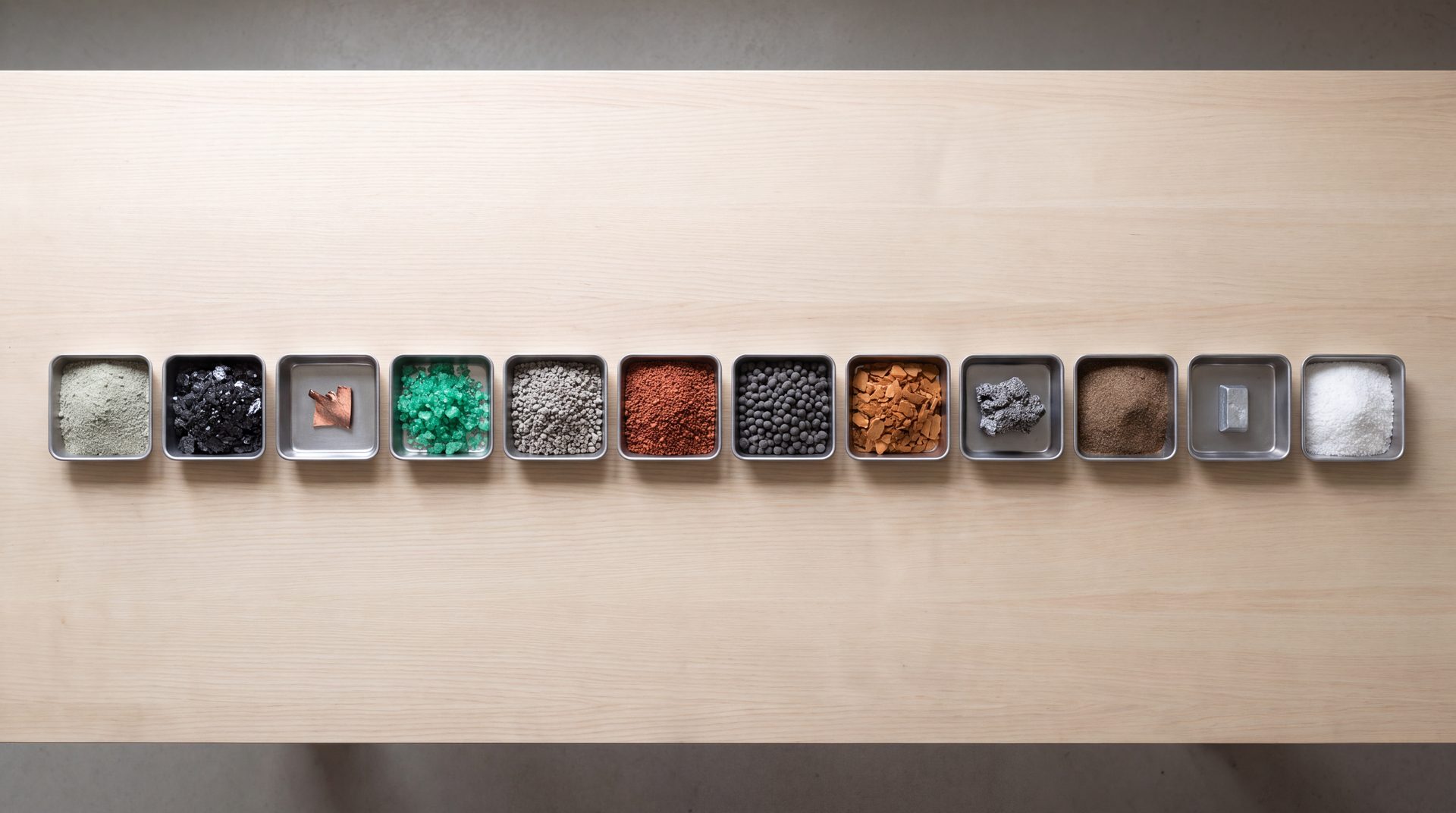
Aircraft, ships, missiles and ammunition depend on a short list of materials. NATO’s list names 12: aluminium, beryllium, cobalt, gallium, germanium, graphite, lithium, manganese, platinum, rare earths, titanium and tungsten.1
Defence
NATO’s 12 defence-critical raw materials
EU import reliance, average 2016 to 2020 (bars), and the country with the largest share of world mining or processing (note). Rare earths are shown as light and heavy.
Source: NATO, list of 12 defence-critical raw materials, 11 December 2024; European Commission, Study on the critical raw materials for the EU (2023), averages 2016 to 2020; USGS, Mineral Commodity Summaries 2026; IEA (2026), Global Critical Minerals Outlook 2026, CC BY 4.0
Germanium is the exception, at 42% import reliance. For the other 11 the EU imported 80% or more of its supply between 2016 and 2020, and for five of them all of it: beryllium, lithium, platinum, rare earths and titanium metal.2
What one platform holds
An F-35 fighter contains more than 400 kg (900 lb) of rare earths, an Arleigh Burke-class destroyer about 2,360 kg and a Virginia-class submarine about 4,170 kg.3
Defence
Rare earths in one defence platform
Kilograms of rare earth elements per unit. The F-35 contains more than 400 kg (900 lb).
Source: CSIS, The consequences of China’s new rare earths export restrictions, 14 April 2025
A Javelin anti-tank missile contains about 250 chips. Guided missiles also need rare earth magnets, gallium radar chips, germanium optics and beryllium gyroscopes.4 A small military drone motor contains about 5 to 15 g of NdFeB magnet.5
Where Europe is exposed
Rare earths. China supplies 98% of the rare earth magnets used in the EU.4 The export licences it has required since April 2025 for seven rare earths remain in force. Bloomberg reported in December 2025 that Beijing was barring sales of rare earths to weapons makers.6
Tungsten. China has required export licences for tungsten since February 2025. Plansee, the Austrian metals group, said in July 2026 that the tungsten price had risen more than sevenfold since then.7 In late October 2026 ammonium paratungstate (APT) traded in Europe at about US$2,500 to 3,100 per metric tonne unit (mtu), according to SMM.8
Antimony. Ammunition primers use antimony trisulphide. In Europe antimony metal reached a record of about US$59,750 a tonne in June and July 2025. On 14 October 2026 it was US$18,300 to 19,000 a tonne in Rotterdam.9
Titanium. The EU produces no titanium sponge and imports all of it. Aerospace takes about 67% of EU titanium demand.10 Before the pandemic Airbus and Safran bought about half their titanium from Russia’s VSMPO-Avisma.4
The industry
Defence industry in Europe
Jobs
633,000
and €183.4bn turnover in 2024
Source: ASD, Facts & Figures 2025
NATO allies agreed in June 2025 to spend 5% of GDP a year by 2035: at least 3.5% on core defence and up to 1.5% on resilience and the defence industrial base.11 The materials in this article matter to both parts.
Stocks, and what is still missing
On 7 July 2026, twelve allies, Luxembourg among them, launched a joint NATO project to buy, store, transport and manage critical raw materials for defence.12 No budget, volumes or materials have been published. Germany, France, the United Kingdom, Poland and the United States are not part of it.
The EU has Security Action for Europe (SAFE), €150bn of loans for joint procurement that may also pay for stocks of raw materials. It also has the European Defence Industry Programme (EDIP): €1.5bn for 2025 to 2027 and powers to impose priority-rated orders for crisis-relevant products.13 On 9 October 2026 the Commission selected 46 more Strategic Projects and said three tungsten and two magnesium projects among them would contribute to defence and aerospace.14
The EU action plan on defence supply chains, promised in the Defence Readiness Roadmap 2030 for the second half of 2026 together with a risk analysis of critical raw materials, had not been published by 30 October.15 From 1 January 2027 US defence contracts also bar tungsten mined, refined or separated in China, Russia, Iran or North Korea.16
Sources
16
- NATO, NATO releases list of 12 defence-critical raw materials, 11 December 2024
- European Commission, Study on the critical raw materials for the EU, 2023 (averages 2016 to 2020)
- CSIS, The consequences of China’s new rare earths export restrictions, 14 April 2025
- JRC, Supply chain analysis and material demand forecast in strategic technologies and sectors in the EU, 2023
- Tech Times, Army depot launches drone motor line, plans 480,000 units to cut China reliance, 1 July 2026 (secondary source)
- Bloomberg, US firms are snapping up the rare earths Europe needs to rearm, 2 December 2025
- Plansee Group, Plansee Group and Almonty extend agreement to ensure supply security, 22 July 2026; IEA Policies database, China’s export controls on tungsten and related items
- SMM, European tungsten market weekly review, 29 October 2026 (secondary source)
- The Defense Post, 11 December 2025; Fastmarkets, Europe’s antimony market faces uncertainty after years of volatility, 15 October 2026
- JRC, The benefits of enhanced circularity on strategic autonomy: titanium metal in the EU, 2025
- NATO, The Hague Summit Declaration, 25 June 2025
- NATO, Allies launch new project on critical raw materials for defence, 7 July 2026
- European Commission, SAFE disbursements, October 2026; Gleiss Lutz, EDIP takes force: new rules for the arms industry and its supply chain, 2026
- European Commission, press release IP/26/2113, 9 October 2026
- European Commission and High Representative, Defence Readiness Roadmap 2030, 16 October 2025
- The Oregon Group, Why tungsten prices are rising so fast: inside the supply crunch, 29 April 2026 (secondary source)
Cite and reuse
Hercinia (2026). Europe’s defence industry runs on twelve materials. Journal, Europe’s Critical Materials Atlas, 30 October 2026. CC BY 4.0.
Text and charts are free to reuse under CC BY 4.0 with this credit. Pictures and the logo are not covered; see the press kit.

What ends on 10 November
China suspended its October 2025 export controls until 10 November 2026.

From 9 December, black mass is hazardous waste
From 9 December 2026 black mass and most lithium-ion battery waste count as hazardous waste in the EU.

Where Europe’s supply sits
The 34 critical raw materials and potash: how much of each the EU imports, at which stage supply concentrates and which products and industries depend on them.